Claude now watermarks its text using Google DeepMind's SynthID-Text. There are no hidden characters to strip. The watermark is the word choice itself. Here's the mechanism, running live on whatever you type.
Try the simulatorEvery word Claude generates is one of two things: a fixed word, or a tournament word. Watch this watermarked sentence generate, one word at a time, and see which is which.
, .
Type or paste anything below. Every word with a plausible alternative competes in a small tournament, seeded by your key and the words right before it. Change the key and watch every outcome change.
Simulation. This runs the same mechanism on a demo key, not Anthropic's key. It cannot detect real Claude text.
Pretend this is text an AI just wrote, since that's what actually gets watermarked. Not a prompt you'd type to an AI, the output it would hand back.
Modify or enter your own text into the box above and watch the watermark confidence metric.
Article 50 of the EU AI Act requires providers to mark AI-generated content in a machine-readable format. Its Code of Practice already has roughly 190 signatories, so most model providers are building their own version of this.EU AI Act
Pictures and documents get C2PA content credentials in their metadata instead of a text watermark. That's a weaker guarantee, since metadata is easy to strip.C2PA
Google measured a 0.01% difference in thumbs-up across roughly 20 million Gemini responses, a gap small enough to be statistically insignificant. Worth noting: thumbs-up is a crude, self-selected signal. Most responses never get rated at all, and it's not built to catch subtle shifts or comparison in word choice.Nature

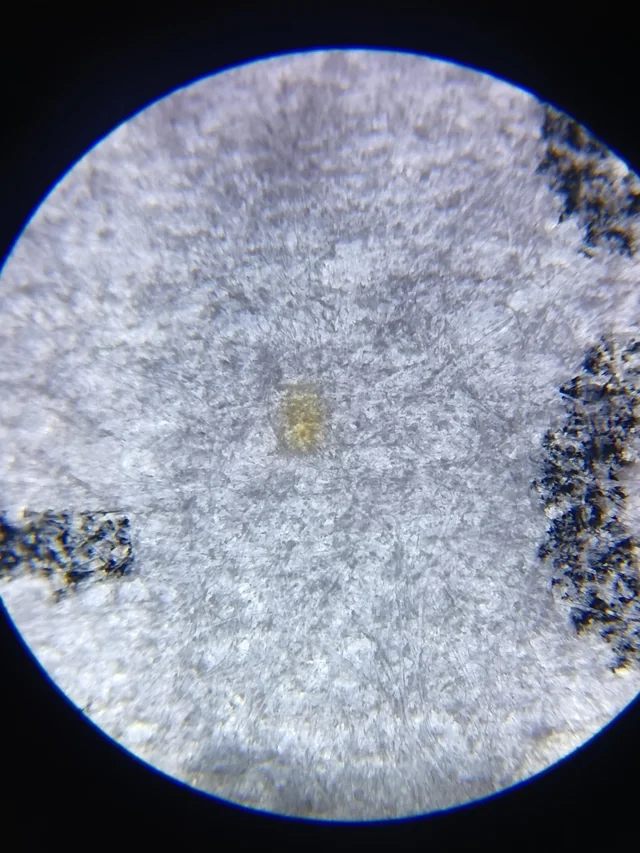
Since the mid-1980s, most color laser printers and copiers have quietly added their own watermark: a grid of near-invisible yellow dots on every page, encoding the printer's serial number and the date and time it printed. Xerox and Canon built it so counterfeiters could be traced back to a specific machine, and nobody outside the printer industry knew the dots existed until 2004.Wikipedia
A single yellow tracking dot, magnified.Source
No. There are no hidden characters, invisible Unicode, or metadata involved. The watermark is the specific words the model chose, and copying or pasting text doesn't change a single word, so it doesn't touch the signal at all.
Neither Anthropic nor Google publishes a minimum word count, but the pattern is consistent: longer passages give the detector more watermarked words to average over, which raises confidence. Very short snippets, like a one-line caption, generally won't carry enough signal to register.
Barely, and that's expected. Code has exact syntax with very few interchangeable word choices, so there's little room to apply a word-choice watermark. However, inline comments within code (and likely pull requests) will carry a full watermark since they involve normal language choices, the same as translations of text.Anthropic
No. The watermark carries no identifying information. It cannot be traced to a user, an organization, or a specific conversation, and it can't confirm human authorship or identify other AI systems either.Anthropic
Google's own measurement, across roughly 20 million Gemini responses using the same SynthID-Text approach, found a 0.01% difference in thumbs-up, small enough to be statistically insignificant. Take that with a grain of salt though: thumbs-up is a crude, self-selected metric, not built to catch subtle shifts or comparison in word choice, and it's not a great measurement of quality to begin with. There's no added cost, no added tokens, and no meaningful speed impact.Nature
Only to the words Claude actually changed. If Claude lightly edits a paragraph you wrote, the watermark lives in those specific edits, which may be too few words to register with any confidence.
Plain English breakdowns of what's actually changing in AI and search, built for marketers. No hype, no hallucinated stats.
Orange Labs is where marketers learn AI by actually using it. Workshops, teardowns, and a community that ships. Finished beats perfect. Mess welcomed in the lab.